
Non Verbal Reasoning
Intent
Non Verbal Reasoning is a tool which helps identify those children with potential that can be hidden in some cases by their less developed verbal skills. It is perhaps for this reason it has become part of the selection process in many schools. It is certainly one of the reasons we work to develop pedagogies for spatial learning.
It provides the opportunity for children to explore and celebrate their abilities outside specific Maths and English lessons, so adds to the diversity of recognised achievements – something we are keen to do.
It provides opportunities for those with the ability to analyse visual information, such as pictures, diagrams and graphs, and solve problems using visual reasoning. It supports problem solving skills without relying on or being limited by their linguistic or mathematical ability. It therefore can harness different learners.
Implementation
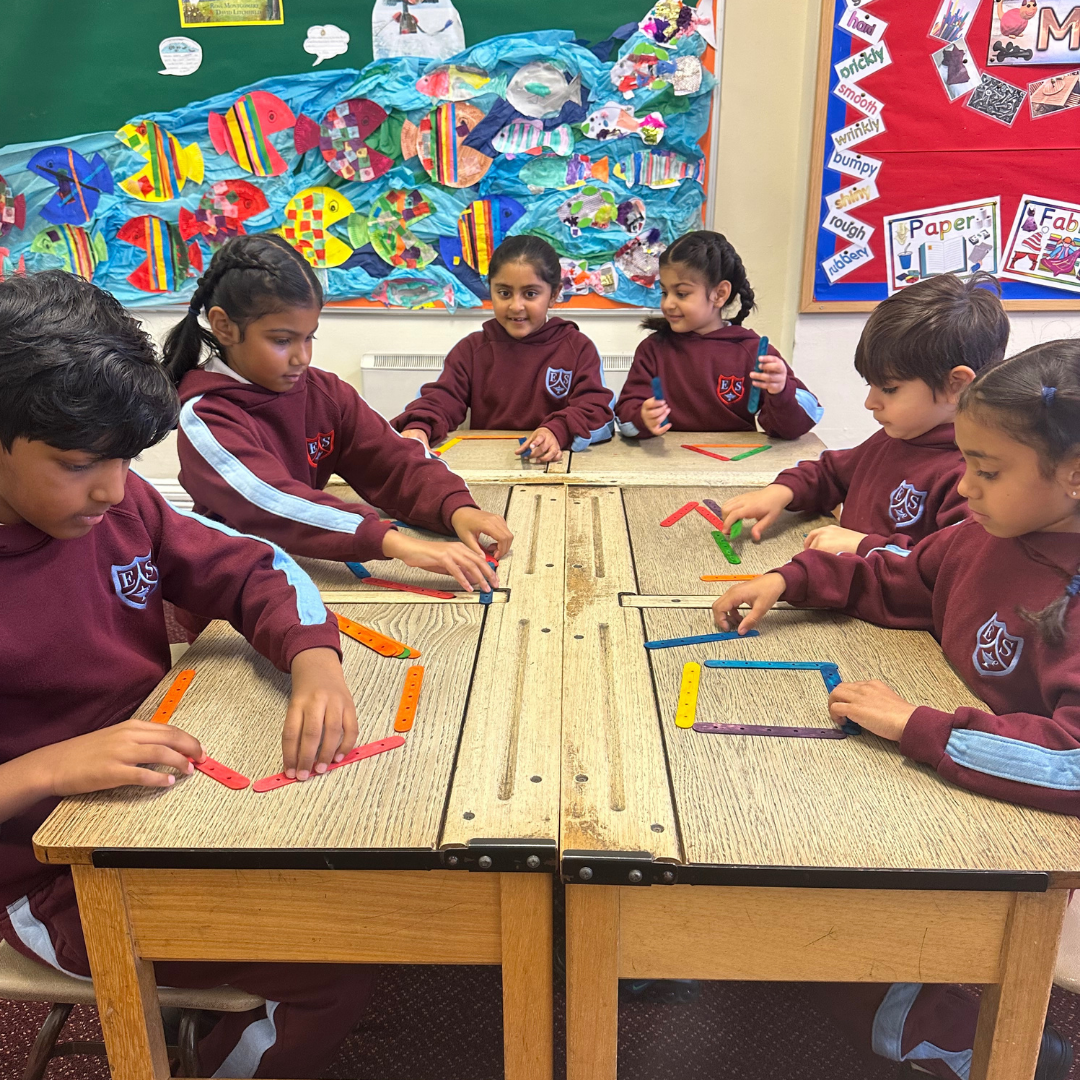
Non-verbal reasoning is taught as a spiral curriculum adding to the range and complexity of questions as children move through the school. The use of manipulatives and games is increasing as new ideas are explored and best practice is shared.
Visual aids can be particularly helpful for non-verbal reasoning question types. When trying to picture several shapes in the head some pupils get confused. Encouraging them to draw the shapes out with a pencil and paper can help them visualise the answer more clearly.
Introducing 3D objects is another way to bring non-verbal reasoning to life and is particularly helpful if the pupil is a kinaesthetic learner. When introducing ‘following folds’ concepts using a piece of paper and hole punch can help the pupil to visualise how the shapes will look when they are reflected, and simple tracing paper helps with rotation.
Games and puzzles also help non-verbal reasoning skills through visualisation and hands-on interaction, for example Minecraft, Lego and other construction kits.
Impact
Helping those who reason best with spatial concepts and may prove to have relative strengths in subjects such as Maths, Science and Design Technology increases motivation for children who fall into this category.
Some skills, particularly those involving spatial awareness, link closely with problem solving using visualisation in Maths. The subject generally has cross-curricular benefits; it encourages concentration, attention to detail and helps build logical thinking skills which are useful in the classroom and beyond.
Strong NVR skills help pupils see how patterns form, and assist in developing their conceptual and imaginative ability. Acquiring these kinds of visual reasoning skills is especially useful for geometry in maths, aspects of science, and computing. It also improves concentration and attention to detail, vital skills in every subject.
Non-verbal reasoning is a form of visual problem-solving using shapes, diagrams and pictures. It develops skills such as:
- Logic and problem-solving
- Spatial awareness
- Ability to identify patterns and rules