
Early Years Foundation Stage
Intent
At Eastcourt we aim to provide motivating first-hand experiences whilst encouraging children to build resilience, ambition and a lifelong love of learning. Our curriculum is designed to recognise children’s prior learning, both from previous settings and their experiences at home. We work in partnership with parents, carers and other settings to provide the best possible start ensuring each individual reaches their full potential from their various starting points.
We recognise that oracy not only improves academic outcomes but is a life skill to ensure success beyond school. Oracy develops children’s thinking and understanding, which in turn promotes self confidence, resilience and empathy which support the child’s wellbeing. Our curriculum is intended to support the children as they begin to link learning to their play and exploraton right from the start. We embed language of learning.
We provide an engaging curriculum that maximises opportunies for meaningful cross-curricular links and learning experiences.
We work on broadening their experiences providing opportunities to try new things and encouraging them to relish a challenge.
We provide high expectations encouraging them to develop perserverance and self-belief.
We help children achieve their potential and support those who need additional help.
We want our children to be:-
Secure and confident; enjoy coming to school and learning new skills and knowledge building on their existing learning.
Skilful communicators; connect with others through language and play, ensuring that they play in a vocabulary rich environment.

Implementation
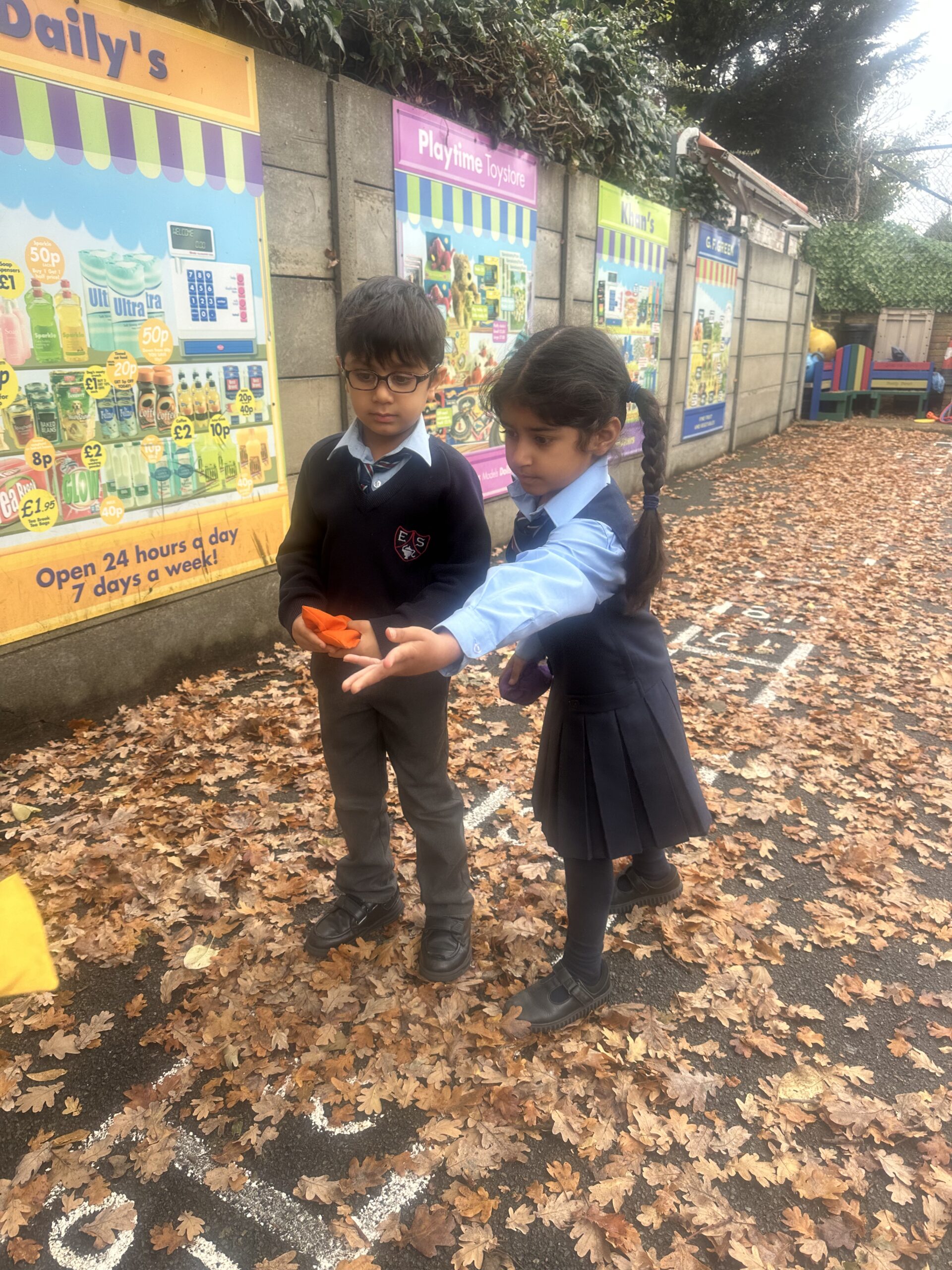
EYFS staff introduce new themes to provide inspiration for learning, whilst providing the flexibilty for children to follow their own interest and ideas. Children learn through a balance of child-initiated and adult-directed activities. They engage in planned, focused activities as well as self-initiated and free flow activites.
We take advantage of cross curricular links in order to combine transferable skills and develop a wide-ranging vocabulary which underpins the childrns learning. This may also include folllowing individual children’s interests and making the most of those focused moments where the teaching and learning can be maximised in a one to one way with teacher and child.
The timetable changes throughout the year to take into consideration the changing needs of the children. Small focused group work means the teacher can systematically check for understanding, identfy and respond to misconceptions quickly and proved real-time verbal feedback which results in a strong impact on the aquisition of new learning.
Children are provided with plenty of time to engage in ‘exploration’ through the variety of experiences carefully planned to engage and challenge them in the provision. The curriculum is planned for both inside and outside, equal importance being given to learning in both areas. There are also planned visitors and visits to widen their experiences. In all aspects of school life we work with parents and support and extend children’s learning, giving and receiving suggestions for ways forward.
Impact
During the first half term in Reception, staff use ongoing assessments, observations and converstaions with the child to develop a baseline assesment. This identifies each individual’s starting points in all areas so we can plan experiences to ensure progress. This information is tracked as part of the Learning Journey.
All ongoing observations are used to inform planning and identify children’s next steps. Staff draw on their knowledge of the child, their profesional judgments, photographs and physical examples such as child’s drawings / making.
Assesments are carried out every half term to quickly identify pupils that are not making expected progress . Our aim is for children to ‘ keep up’ rather than ‘catch up’ where possible.
Assesments are shared with parents at Christmas and during the Spring term. In the Summer term they will be assesed as ’emerging’ ‘expected’, or ‘exceeding’. Teachers provide a narrative for both parents and the Year 1 tecaher documenting progress made.
The ulimate goal is for the children to leave EYFS happy and confident with the skills, knowledge and confidence to continue their journey as scientists, historians, artists, geographers, authors and mathematicians.
